
RenoSmarter.ai
Product Portfolio
Overview
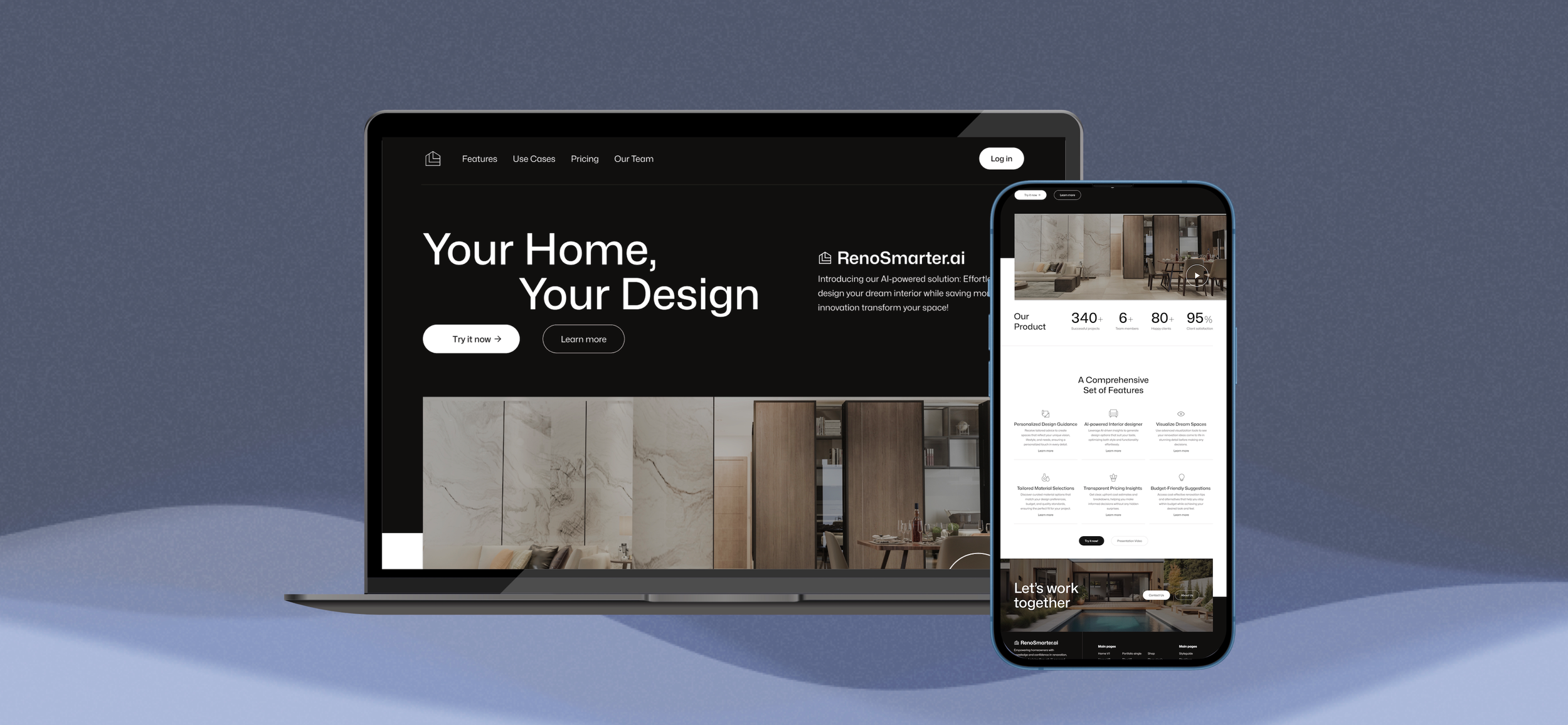
RenoSmarter.ai is an innovative platform designed to redefine the home renovation process. By integrating AI with user-friendly design tools, RenoSmarter.ai empowers homeowners, renovation enthusiasts to make informed decisions, design dream spaces, and manage renovation costs effectively.
Check out our website here and try our product: RenoSmarter.ai
My Role
As a product manager, I led the development of an AI-powered home renovation tool from inception to launch. I conducted market and competitor research, and organized client interviews to understand user pain points and validate the product. Working with business stakeholders, I defined the product vision and roadmap. I collaborated with the development team to create and refine the AI model, ensuring quality and compliance.
Moreover, I managed the MVP launch, overseeing design and deployment, and prioritized user feedback to iterate and improve the product. I also worked with marketing and sales teams to drive user adoption and successfully transition from MVP to official launch.
Background - Product Inspirations
Home renovation projects are complex undertakings that blend creativity, practicality, and financial prudence. However, many homeowners and aspiring renovators encounter significant obstacles during the process, primarily due to insufficient guidance and resources. These challenges often manifest in several key areas, ultimately leading to suboptimal results, budget overruns, and overall dissatisfaction:
1. Lack of Accessible Information
Many homeowners and renovators lack the basic knowledge required for effective planning and execution of renovation projects. This often leads to costly mistakes and dissatisfaction with renovation outcomes.
2. Challenges in Envisioning
Without professional help, visualizing the end result of a renovation project is challenging for most individuals. This can result in designs that don’t meet expectations or fail to utilize spaces efficiently.
3. Inconsistent Cost Estimations
Current methods for estimating material costs are often inaccurate, leading to budget overruns that can severely impact the overall project. Homeowners frequently struggle with adapting project scopes to fit their financial limits.
Today’s Solutions and Drawbacks

Online Guides/Blogs
Usually provide broad advice that often fails to account for specific renovation types or local market conditions.

Traditional Softwares
Either too complex for non-professionals or lack the ability to produce accurate, realistic simulations.

Manual Costing
Reliance on multiple sources or experts for cost estimates makes the process inefficient and error-prone.
AI Hypothesis - PMF Proposition
“If we deliver the visible AI result in the form of personalized interior design plans with outstanding cost estimations to homeowners/renovators, they are in a position to make informed renovation decisions and proceed confidently with their projects, which in turn creates value by streamlining the renovation process and enhancing pricing transparency, which we can capture a percentage through service fees or commissions on materials and services.”
Research Design
Home renovation projects are complex undertakings that blend creativity, practicality, and financial prudence. However, many homeowners and aspiring renovators encounter significant obstacles during the process, primarily due to insufficient guidance and resources. These challenges often manifest in several key areas, ultimately leading to suboptimal results, budget overruns, and overall dissatisfaction:
1. Lack of Accessible Information
Many homeowners and renovators lack the basic knowledge required for effective planning and execution of renovation projects. This often leads to costly mistakes and dissatisfaction with renovation outcomes.
2. Challenges in Envisioning
Without professional help, visualizing the end result of a renovation project is challenging for most individuals. This can result in designs that don’t meet expectations or fail to utilize spaces efficiently.
3. Inconsistent Cost Estimations
Current methods for estimating material costs are often inaccurate, leading to budget overruns that can severely impact the overall project. Homeowners frequently struggle with adapting project scopes to fit their financial limits.
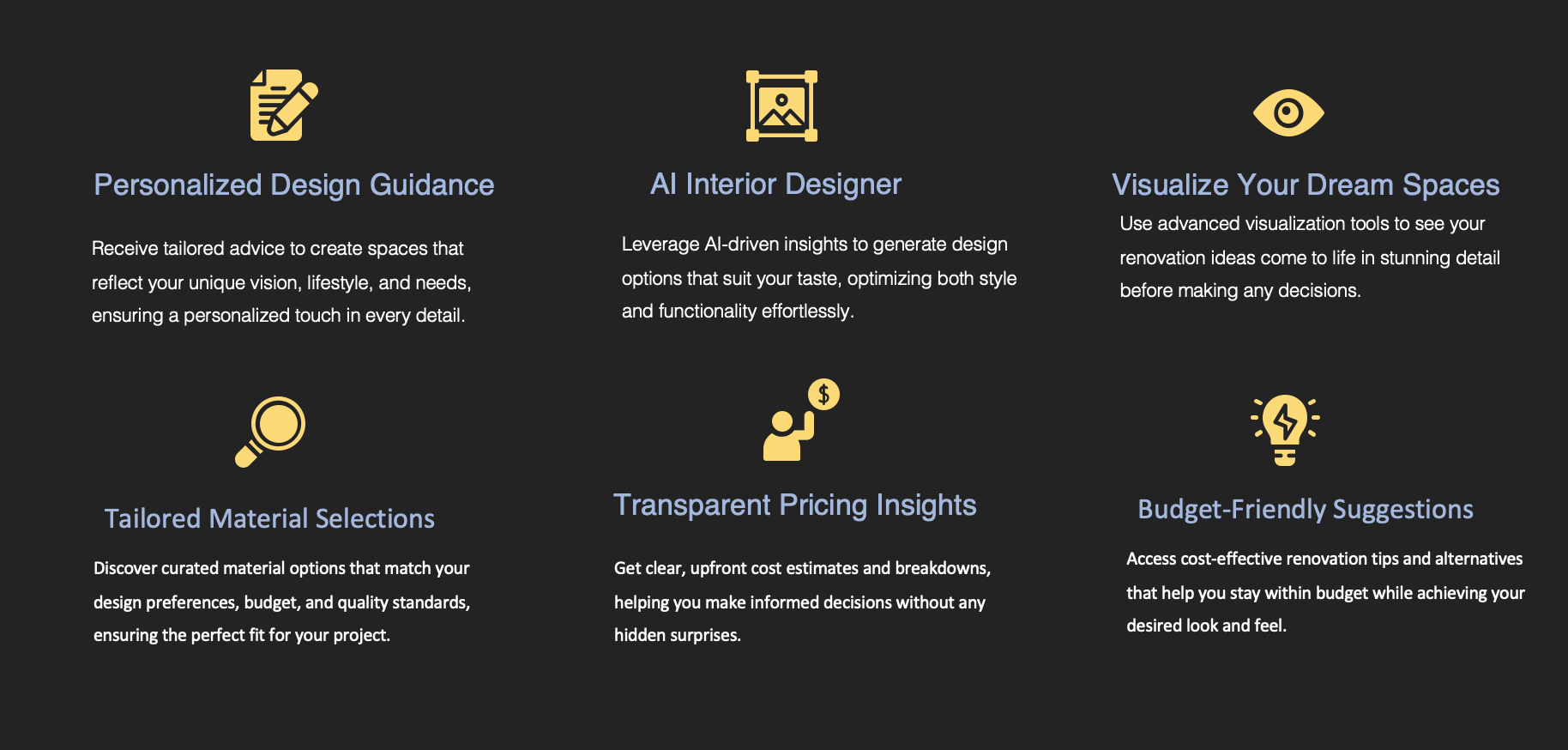
Our AI-Powered Solutions
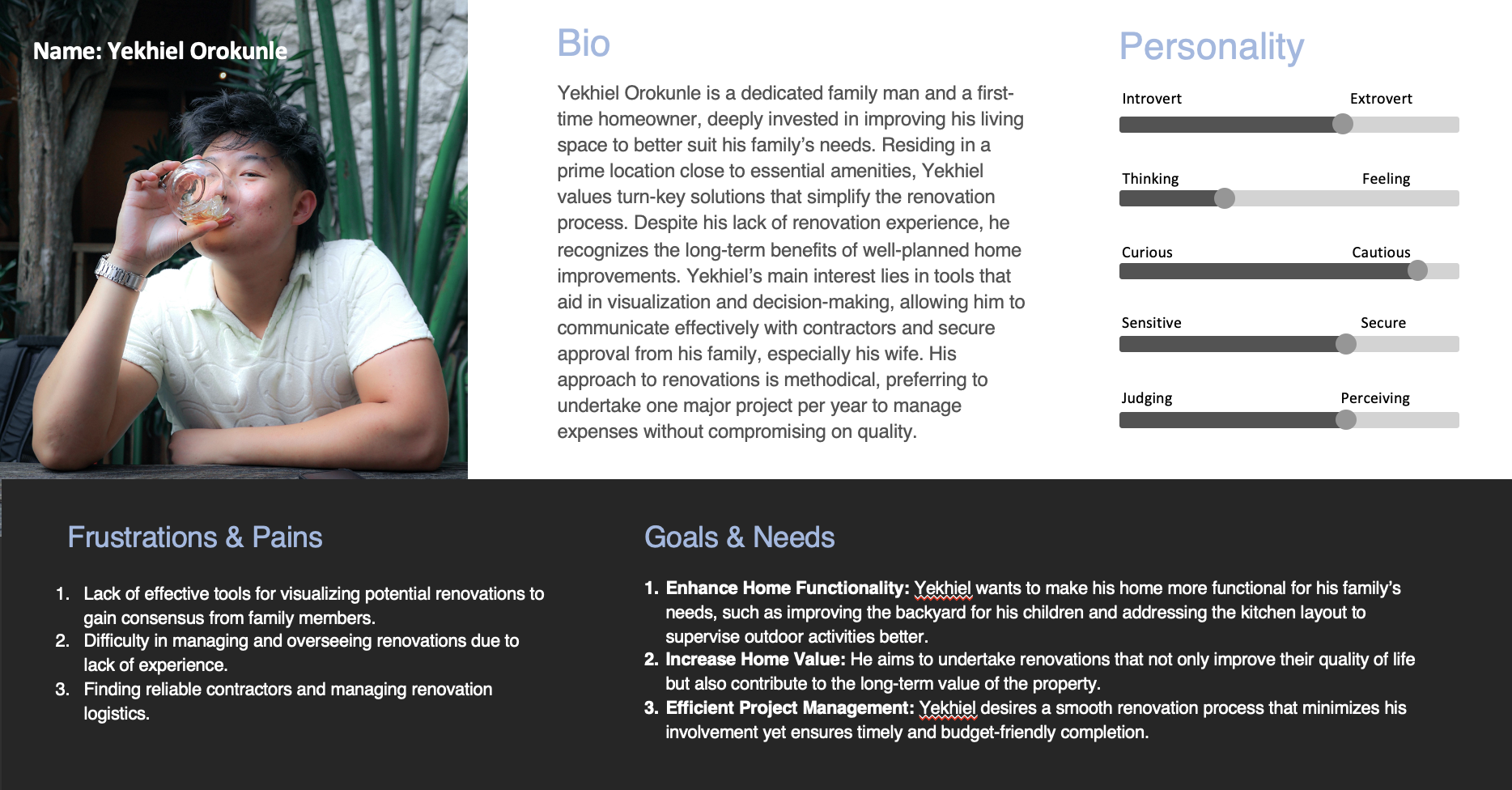
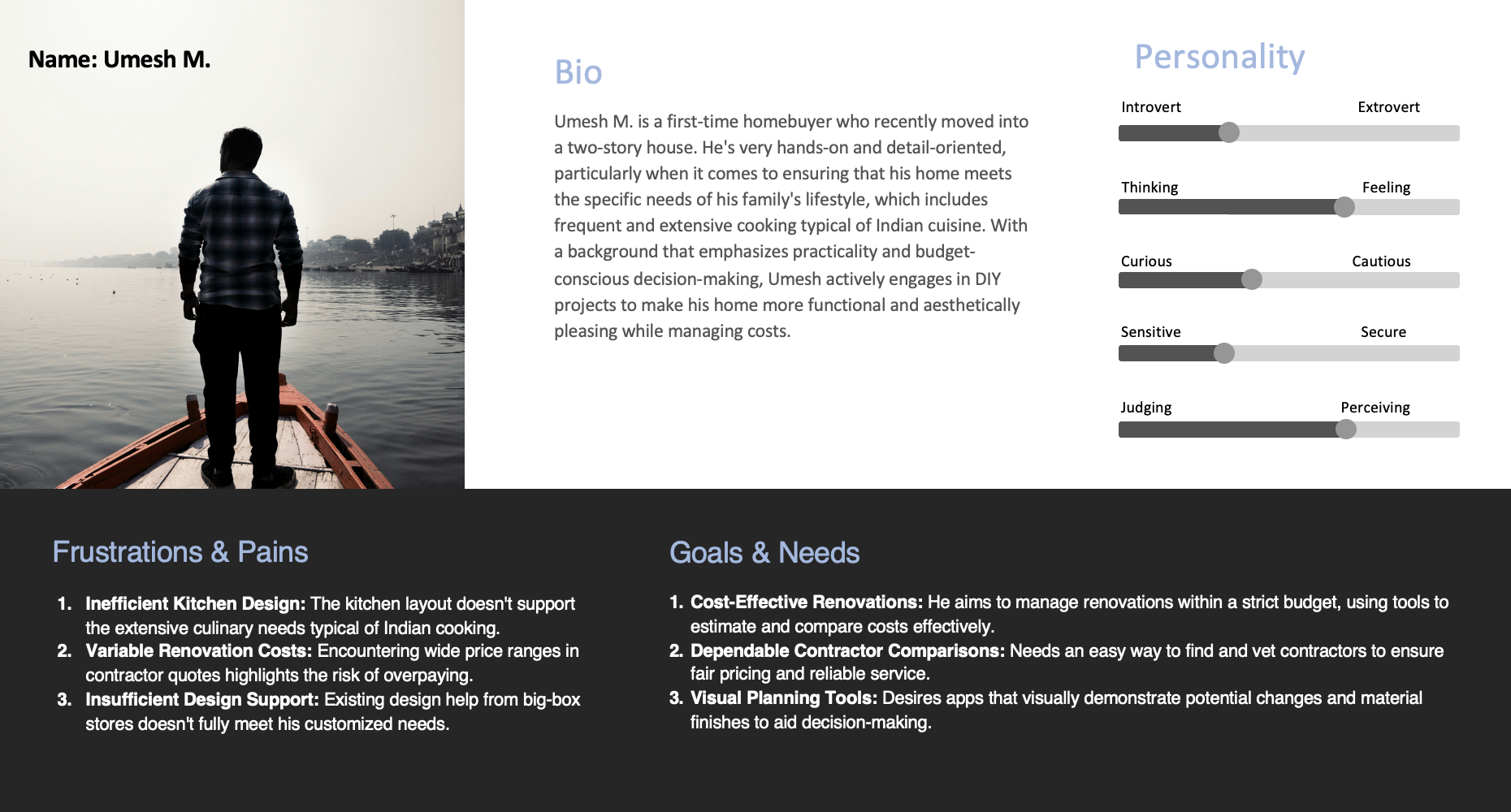
Customer Persona
GTM Strategy
ToFu (Attention):
Attention through social media marketing. (i.e., 30 second ads on IG, Dr. Li's promotions, etc.)
MoFu (Consideration):
If potential customers click the link to see a demo video of the product, then we have their contact information.
With the contact information, we can send newsletter like information about current interior design trends, more in depth example popular interior designs (i.e., traditional, modern, transitional, etc.)
All newsletters will have link to ask the customer to make an account and try out the product.
BoFu (Decision):
Customer made the account and completed one design cycle. Ratings are a plus, but not required.
System Architecture of MVP
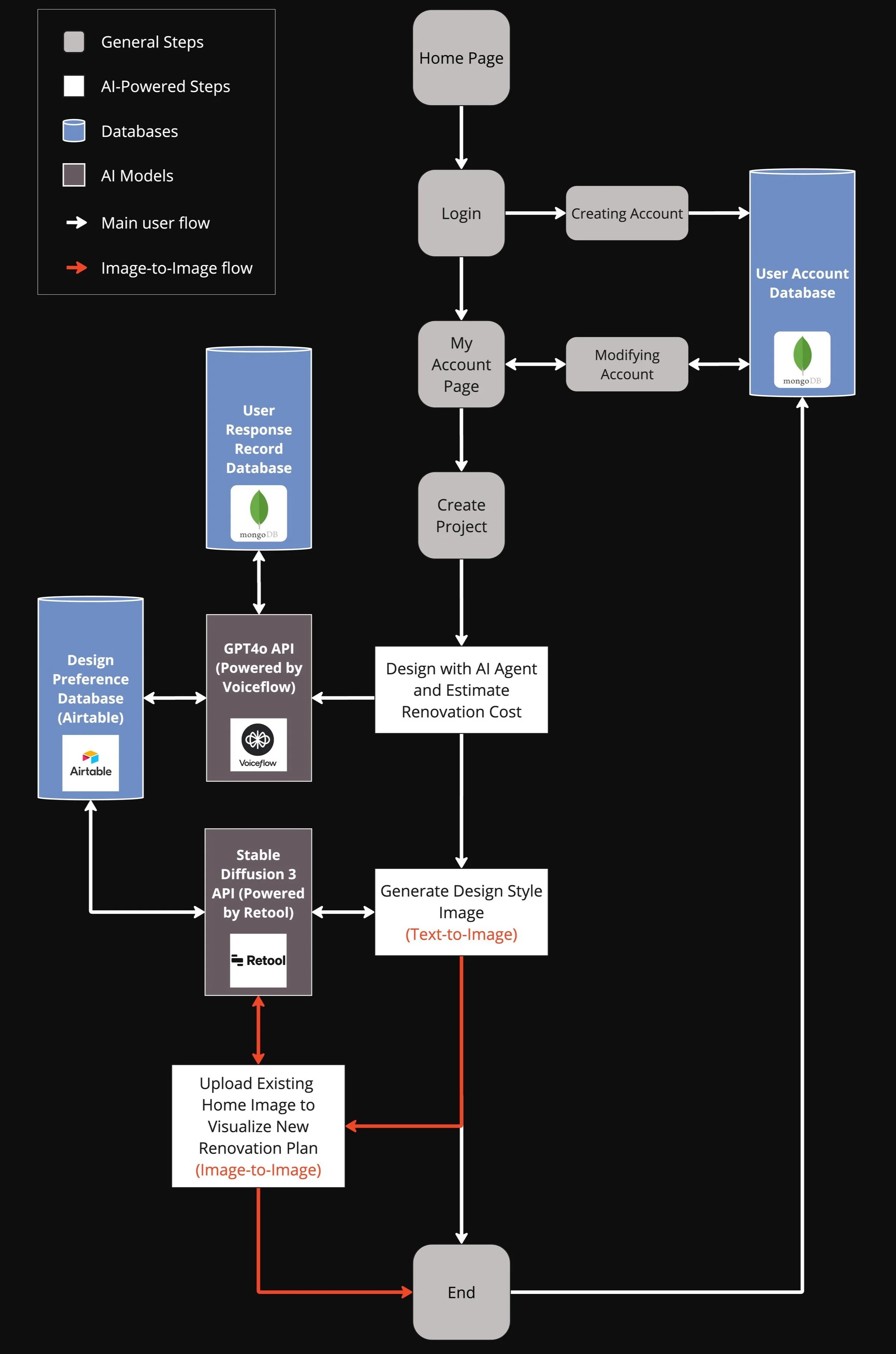
Launched MVP in 2 months
Product Roadmap
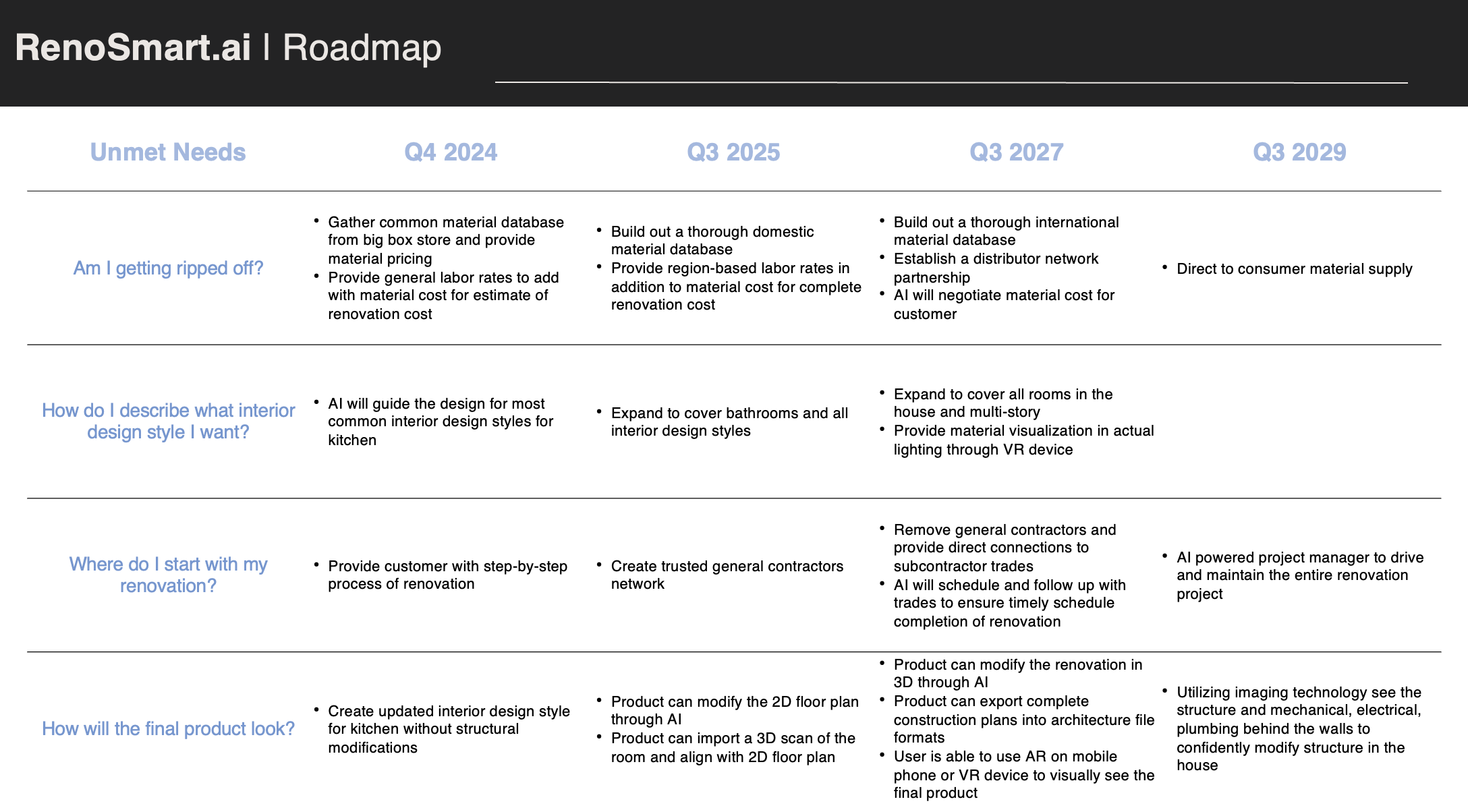
Summary - Build AI Product From 0 to 1
Ideation & Validation
1. Identify the Problem and Define the Solution:
Conduct market research to understand the pain points
Gather feedback from potential users to refine the problem statement
Define the core features and functionalities of the AI tool
2. Research Analysis:
Analyze existing solutions in the market to identify gaps and opportunities
Determine the unique selling points (USPs) of our AI tool
3. Validate the Idea:
Create a minimum viable product (MVP) or prototype to test with a small group of users
Gather feedback to validate the idea and make necessary adjustments
Development & Testing
1. Build the AI Model:
Collect and preprocess data from various insurance policies
Develop and train the AI model to accurately check and analyze insurance policies
2. Develop the Product:
Design the user interface (UI) and user experience (UX) for the tool
Implement the backend and frontend development, integrating the AI model with the application
3. Testing and Iteration:
Iterate based on feedback from testing to improve the product's accuracy and usability
Perform beta testing with a broader audience to gather more feedback and identify any final issues
MVP & Launch
1. Pre-Launch Preparation:
Develop a marketing and go-to-market strategy
Prepare documentation and training materials for users
Set up customer support channels to assist users post-launch
2. MVP:
Launch MVP to pilot with an existing client to get feedback and continue to prepare for product launch
Monitor the pilot closely to address any immediate issues or feedback
3. Launch:
Officially launch the product to the public omni-channels
Maintain active customer support and engagement to ensure user satisfaction and retention